
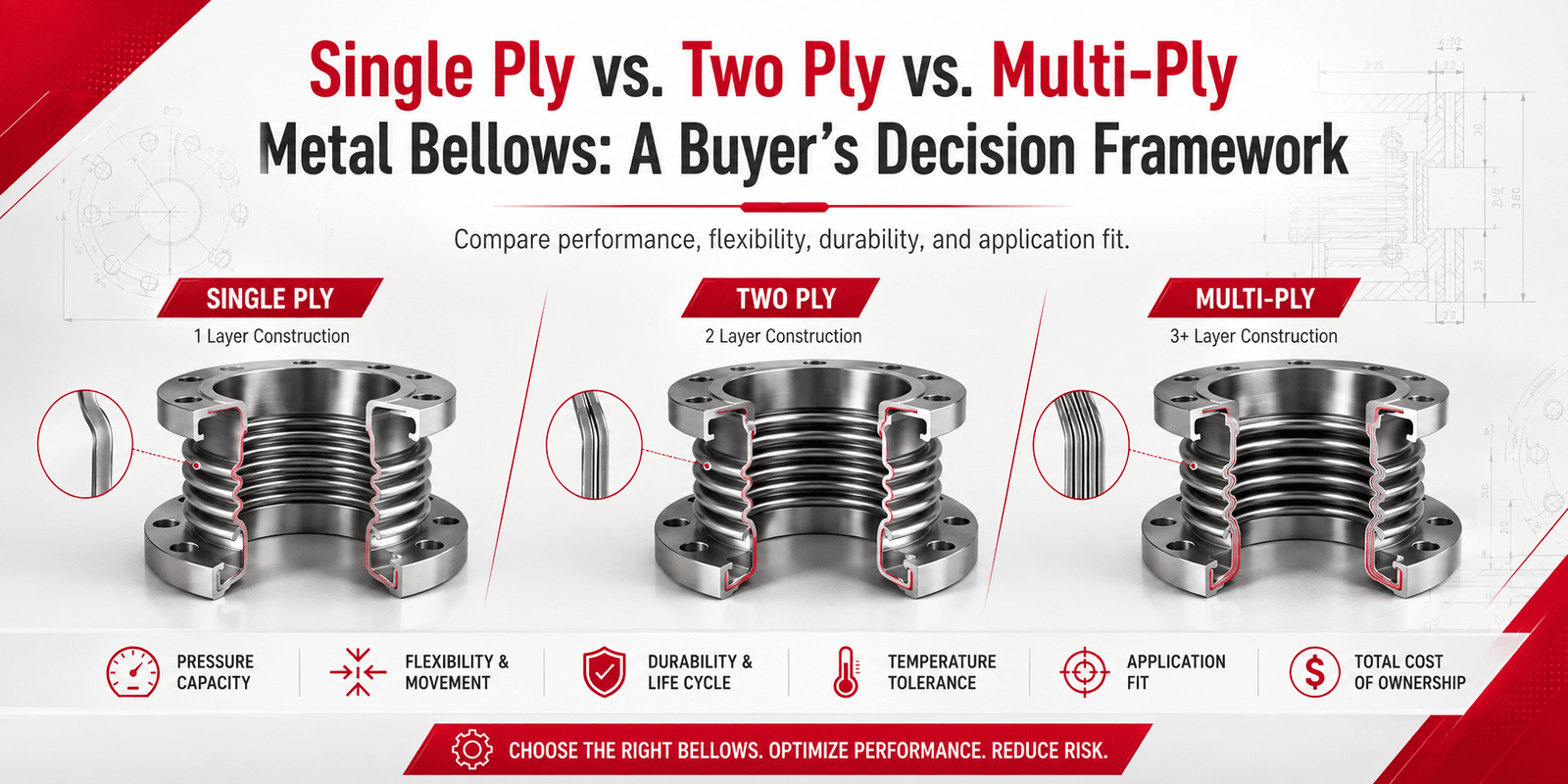
When you’re specifying a metal bellows, one of the first decisions you’ll face is how many plies — layers of material — your bellows element needs. It seems like a simple technical choice, but it has significant consequences for cost, service life, spring rate, pressure capacity, and fatigue performance.
This guide breaks down exactly what each ply configuration offers, where each falls short, and how to match the right ply count to your actual application.
What Does 'Ply' Mean in Metal Bellows?
In metal bellows manufacturing, a ‘ply’ refers to a single layer of material formed into the convolution profile of the bellows. A single-ply bellows has one layer. A two-ply bellows has two concentric layers formed together. A multi-ply bellows has three or more layers.
The plies are formed together as a unit — they move together as the bellows compresses, extends, or deflects laterally. The key differences between ply configurations show up in pressure capacity, spring rate (the force required to move the bellows), cycle life, and manufacturing cost.
Single Ply Bellows
What It Is
A single-ply bellows is formed from a single tube of material. The convolutions are formed using mechanical punch forming or hydroforming, creating a flexible element that can absorb movement in axial, lateral, or angular directions.
What It Does Well
- Lowest spring rate — requires the least force to move, minimizing loads on adjacent piping or equipment
- Best flexibility for a given convolution geometry
- Most cost-effective option for straightforward applications
- Easiest to manufacture in a wide range of sizes, from very small OEM components up to large pipe sizes
- Well-suited for small axial movements in low-to-moderate pressure applications
Where It Falls Short
- Lower pressure capacity compared to multi-ply at the same wall thickness
- More susceptible to fatigue failure under high cycle counts
- Not recommended for applications with large movements, high pressures, or demanding thermal cycling
Best Applications for Single Ply
- Mechanical seals and actuators where low spring rate is critical
- Fluid management components: accumulators, volume compensators
- Low-pressure piping expansion joints with small movements
- OEM components in instruments and precision equipment
Learn more about our single ply options: See the Bellows Systems Single Ply Bellows page.
Two Ply Bellows (Pipe Bellows)
What It Is
A two-ply bellows uses two concentric layers of thinner material formed together into the convolution profile. The two plies work together mechanically, and the combined structure behaves differently from simply doubling the wall thickness.
What It Does Well
- Better pressure capacity than single ply at the same overall diameter
- Improved fatigue life — the load is distributed across two layers, reducing peak stress at any single point
- Good spring rate balance — stiffer than single ply but still flexible enough for piping applications
- Wider operating range — handles larger movements than comparable single-ply elements
- Better redundancy — if a pinhole leak develops in one ply, the second ply continues to contain the media
Where It Falls Short
- Higher spring rate than single ply — can introduce more load into the piping system
- More expensive than single ply due to additional material and forming operations
- Not rated for the highest-pressure or extreme temperature applications
Best Applications for Two Ply
- Process piping expansion joints in chemical plants, refineries, and power generation
- Gas and liquid piping systems with moderate pressure and temperature
- Applications requiring extended cycle life without the cost premium of multi-ply
- Where redundancy against through-wall failure adds safety value
Multi-Ply Bellows
What It Is
Multi-ply bellows use three or more layers of material — with each ply typically thinner than what would be used in a single or two-ply design. Bellows Systems specializes in multi-ply bellows with high cycle life, using state-of-the-art seam welded tube technology.
What It Does Well
- Highest pressure capacity of any bellows configuration at a given diameter
- Engineered for demanding cycle life — used in applications with thousands of thermal or pressure cycles
- Thinner individual plies mean lower stress per ply, extending fatigue life significantly
- Can be designed to specific spring rate, cycle life, and pressure targets
- Essential for high-temperature, high-pressure, and high-vibration environments
Where It Falls Short
- Higher cost due to complex manufacturing and precision material requirements
- More technically demanding to specify — requires engineering input on ply count, thickness, and convolution geometry
- Not necessary (and therefore overcost) for simple, low-demand applications
Best Applications for Multi-Ply
- Engine exhaust systems (Caterpillar, Waukesha, Solar Gas Turbines) with continuous thermal cycling
- Aerospace and defense applications requiring certified fatigue life
- Subsea and high-pressure oil and gas applications
- Power generation systems with startup/shutdown cycle requirements
- Any application where EJMA design calculations must be documented
Side-by-Side Comparison
| Factor | Single Ply | Two Ply | Multi-Ply |
|---|---|---|---|
| Pressure Capacity | Moderate | Good | Highest |
| Cycle Life | Basic | Good | Engineered (highest) |
| Spring Rate | Lowest | Moderate | Higher (tunable) |
| Movement Range | Small | Moderate | Application-specific |
| Cost | Lowest | Mid | Higher |
| Leak Redundancy | None | One backup ply | Multiple backup plies |
| Engineering Complexity | Low | Moderate | High |
| Best Fit | OEM, instruments, seals | Process piping, general industrial | Exhaust, high-P/T, aerospace |
The Decision Shortcut
If you answer yes to any of the following, step up to multi-ply:
- Operating temperature above 900°F (482°C) continuously
- More than 5,000 thermal or pressure cycles per year
- Operating pressure above the single or two-ply catalog limit for your bore size
- Application is in aerospace, defense, or a safety-critical system requiring documented fatigue life
- Media leakage would be a safety or environmental incident
If none of those apply, two-ply is usually the right balance of performance and cost for process piping and industrial applications. Single ply is correct for low-pressure, low-cycle OEM components.
Not sure which ply configuration fits your application? Our engineers will tell you — (800) 233-0623 | bellows-systems.com/get-quote
Related Resources
- Single Ply Bellows — specifications and applications
- Two Ply Bellows — pipe bellows details
- Multi Ply Bellows (High Pressure) — engineered for demanding service
- Testing and Qualification — how BSI validates bellows performance
- EJMA Design Standards (External) — Expansion Joint Manufacturers Association