
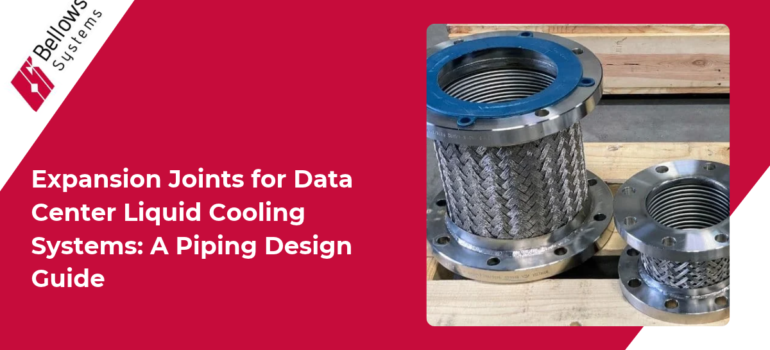
Expansion Joints for Data Center Liquid Cooling Systems: A Piping Design Guide
Summary:
Expansion joints for data center cooling absorb thermal growth, equipment vibration, and settlement in chilled water and liquid cooling piping, so pipes, pumps, chillers, and coolant distribution units (CDUs) are not overstressed. Use metal bellows joints where thermal movement or pressure thrust must be controlled, and use elastomeric joints near pumps and chillers for vibration and noise. Always pair every joint with correctly placed anchors and guides, size for real movement and pressure, and choose materials compatible with the coolant. A joint that leaks in a live data hall is a high-consequence failure, so the design must prioritize reliability over lowest first cost.
- Liquid cooling raises the stakes: dense racks, tight maintenance windows, and water close to IT equipment mean low tolerance for leaks or unplanned shutdowns.
- Pipe growth is predictable. Carbon steel grows about 0.39 in over 100 ft for a 50°F temperature change. Over long headers and risers, that movement must go somewhere.
- A bellows joint is only as good as its anchors and guides. Most field failures trace back to missing or misplaced restraints.
- Pressure thrust (pressure multiplied by effective area) can be far larger than the thermal force. Unrestrained joints need main anchors that can carry it.
- Specify movement, pressure, temperature, coolant, cycle life, and test requirements on the datasheet so the manufacturer can engineer the right joint.
1. Why Data Center Liquid Cooling Changes Piping Design
Air cooling is reaching practical limits as rack densities climb with AI and high-performance computing. Operators are moving to direct-to-chip cold plates, rear-door heat exchangers, and immersion cooling, all of which move heat with liquid. That shifts a lot of thermal management into piping networks.
A typical liquid-cooled facility has two broad loops:
- Facility water system (FWS): chillers, cooling towers or dry coolers, large-diameter headers, and pumps that carry heat out of the building.
- Technology cooling system (TCS), also called the secondary loop: CDUs that exchange heat with the facility loop and distribute coolant to rack manifolds and cold plates, often using a treated water or water-glycol mixture.
Both loops see temperature swings during commissioning, load ramps, seasonal changes, and maintenance shutdowns. Both also connect to rotating equipment that transmits vibration. Expansion joints (also called bellows) are one of the main tools designers use to control that movement without overloading nozzles, flanges, and welds.
Guidance bodies such as ASHRAE TC 9.9 and the Open Compute Project publish liquid cooling temperature classes and loop architectures. Those documents shape supply and return temperatures, but the mechanical piping design is still governed by the applicable piping code, typically ASME B31.9 for building services piping or ASME B31.3 for process piping, as selected by the project engineer of record.
2. Where Expansion Joints Are Used in a Cooling Loop
Parameter 1: Operating Pressure
Expansion joints appear in predictable locations. Mapping them early makes both the pipe stress analysis and the bill of materials cleaner.
| Location | Main purpose | Typical joint choice |
| Chiller inlet and outlet connections | Isolate vibration, absorb small movement, protect nozzles | Elastomeric (rubber) joint or metal bellows with tie rods |
| Chilled water pump suction and discharge | Reduce noise and vibration transfer | Elastomeric joint, often with control rods |
| Long straight headers and risers | Absorb thermal growth between anchors | Axial metal bellows with guides |
| Building expansion gaps and seismic joints | Accommodate lateral and angular movement | Universal tied or hinged bellows |
| CDU primary (facility-side) connections | Reduce load on CDU nozzles and plate heat exchangers | Metal bellows or flexible connectors |
| CDU secondary (rack-side) distribution | Allow for installation tolerance and thermal movement | Flexible hoses or small-bore bellows, per OEM guidance |
| Heat rejection equipment (dry coolers, towers) | Absorb movement from equipment and roof structure | Metal bellows or elastomeric joints |
For engineered metal bellows used on larger headers and equipment connections, see our metal expansion joints. For pump and chiller isolation, see our rubber expansion joints. If your layout has tight offsets or multi-plane movement, explore universal expansion joints.
3. What Movements the Piping Must Absorb
Before choosing a joint, define the movement it must handle.
Thermal growth. Pipe length changes with temperature. For carbon steel, a rule-of-thumb coefficient is about 6.5 × 10⁻⁶ in/in/°F. A 100 ft straight run with a 50°F swing grows about 0.39 in. Stainless steel grows roughly 40 to 50 percent more than carbon steel for the same temperature change, so mixed-material systems need extra attention.
Equipment movement. Chillers, pumps, and CDUs can shift slightly under thermal and operating loads. Vibration from compressors and pumps travels through rigid piping.
Building movement. Structural settlement, slab deflection, roof movement, and seismic drift all introduce lateral and angular offsets. Data centers in seismic zones need joint selection coordinated with the structural engineer and the applicable seismic requirements.
Pressure effects. Pressure does more than load the pipe wall. In an unrestrained bellows, internal pressure acts on the effective area and creates axial thrust. As an illustration only, a joint with an effective area of around 45 in² at 100 psi produces roughly 4,500 lbf of thrust that the anchors must resist.
Cold-start and drain-down. Liquid cooling loops are often filled, flushed, pressure tested, and cycled before the first server arrives. These commissioning events count toward the joint’s cycle life.
4. Expansion Joint Types and When to Use Each
Single axial (unrestrained) bellows
Absorbs axial compression and extension in a straight run. Needs a main anchor at each end of the run and guides on both sides of the joint. Best for long headers and risers with clear anchor points.
Tied universal bellows
Two bellows separated by a spool, with tie rods that restrain pressure thrust. Absorbs lateral movement while the tie rods carry the thrust, so lighter supports can be used. Useful near equipment and where anchors are impractical.
Hinged and gimbal bellows
Designed for angular rotation in one plane (hinged) or any plane (gimbal), usually used in pairs or sets in a offset leg. They carry thrust through hinge hardware and are effective in tight mechanical rooms.
Pressure-balanced bellows
Use an additional balancing bellows so pressure thrust is cancelled within the assembly. Helpful at pump and chiller nozzles where external loads must be kept very low.
Elastomeric (rubber) expansion joints
Reduce vibration and noise and absorb small movements. They are not typically the choice for large thermal growth. Check temperature and pressure ratings, coolant compatibility, and control rod requirements.
Flexible hoses and connectors
Used at the rack and CDU secondary level where small offsets, vibration, and installation tolerance matter. Follow the CDU and rack manifold OEM’s approved components.
Quick selection logic:
- Large thermal movement, defined anchors → single axial bellows with guides.
- Lateral offset or limited space → tied universal or hinged bellows.
- Equipment isolation, vibration, noise → elastomeric joint with control rods, or bellows where higher temperature or pressure applies.
- Low allowable nozzle loads → pressure-balanced design.
5. Pipe Stress Basics for Chiller and CDU Piping
Data center chiller piping stress analysis is usually done in software that follows the chosen code. The goal is to confirm that expansion stress, sustained stress, and nozzle loads remain within allowable limits for every operating and upset case.
Focus on these points:
- Load cases. Include installed, hydrotest, normal operation, minimum temperature, maximum temperature, and any transient such as a chiller changeover.
- Equipment allowable loads. Get nozzle load limits from chiller, pump, CDU, and plate heat exchanger manufacturers. Plate heat exchangers and CDU manifolds are often sensitive to external loads.
- Flexibility first. Where space allows, loops, offsets, and changes of direction can absorb movement without joints. Use bellows where layout makes natural flexibility impractical.
- Model the joint properly. Include axial, lateral, and angular stiffness, effective area, and the movement rating from the manufacturer’s data. Do not model a bellows as zero stiffness and unlimited movement.
- Check thrust. Verify that anchors, supports, and building structure can resist pressure thrust plus spring forces and friction.
- Include fatigue. Estimate the number of full-range thermal cycles over design life. Cycle life ratings in EJMA-based calculations vary with movement, pressure, and material.
Manufacturers commonly design metal bellows per the Expansion Joint Manufacturers Association (EJMA) standards. Ask for design calculations and cycle life values with the quote, not after the order.
6. Anchors, Guides, and Supports
In practice, restraint design decides whether an expansion joint succeeds.
- Main anchors sit at changes of direction and at the ends of a run. They resist pressure thrust and spring force.
- Intermediate anchors divide a long run into independent expansion zones.
- Pipe guides keep the pipe aligned so the bellows moves only in its designed direction. A typical rule is to place the first guide within four pipe diameters of the joint and the second within fourteen diameters from the first. Confirm exact spacing with the manufacturer’s recommendation.
- Supports must not restrain the intended movement and must not allow the joint to carry pipe weight.
A common field failure: guides missing or too far away, so the pipe buckles (squirm) under pressure, damaging the bellows. Include guide locations on the isometrics and confirm them in the submittal review.
7. Material and Coolant Compatibility
Cooling loops use treated water, glycol mixtures, or specialty dielectric or engineered fluids in some designs. The joint materials must suit the fluid, temperature, and water chemistry.
- Bellows: 304/304L and 316/316L stainless steel are common. Higher-chloride environments or aggressive treatment chemicals may call for upgraded alloys. Confirm with the water treatment provider.
- Ends: Flanged, weld-end, or grooved connections, matched to the pipe class and the operator’s maintenance standards.
- Liners and covers: Internal sleeves reduce flow-induced vibration at higher velocities. External covers protect the bellows during construction.
- Elastomers: EPDM is common for water and glycol service; confirm compatibility with inhibitors, biocides, and any fluid additives.
- Cleanliness: Liquid-cooled IT hardware has fine passages in cold plates. Specify cleaning, capping, and particulate control for joints supplied to the CDU secondary loop.
- Galvanic and corrosion control: Watch dissimilar metals and stagnant zones that can form around convolutions.
8. Selection and Specification Checklist
Provide this information when requesting a quote so the manufacturer can engineer the right joint:
- Line size, pipe class, and end connections
- Fluid (water, water-glycol percentage, other) and any chemical treatment
- Design and operating pressure, test pressure
- Design, minimum, and maximum temperature
- Axial, lateral, and angular movements, including installation tolerance
- Expected number of full thermal cycles over design life
- Flow velocity (to decide if internal liners are needed)
- Allowable loads at connected equipment
- Seismic requirements
- Space constraints and orientation
- Testing and documentation (material certs, pressure test, dimensional reports, design calculations)
- Cleanliness and packaging requirements
Have a complex layout? Our team can review your drawings and recommend a configuration. Request a technical review.
9. Installation, Commissioning, and Maintenance
Installation
- Remove shipping bars only after the joint is installed and anchored, following the manufacturer’s instructions.
- Install in the correct flow direction if an internal liner is used.
- Do not use the bellows to correct misalignment unless it is designed for it.
- Avoid torsion during bolting.
Commissioning
- Confirm anchors and guides are complete before filling and pressure testing.
- Vent air carefully, since trapped air can cause pressure surges and noise.
- Record baseline movement readings at first heat-up.
Maintenance
- Inspect for leaks, corrosion, deformation, and bellows squirm during scheduled rounds.
- Check guides and anchors for wear or loosening.
- Track cycles and compare with the design life.
- Plan for replacement during scheduled outages, not emergencies. Keep critical spares for single points of failure.
10. Common Mistakes to Avoid
- Choosing a joint after the layout is frozen and having no room for anchors.
- Ignoring pressure thrust and undersizing anchors.
- Using rubber joints where large thermal movement is expected.
- Skipping guides or spacing them too far apart.
- Not accounting for commissioning and flushing cycles in cycle life.
- Ignoring water chemistry and chloride levels.
- Treating the joint as a pipe support.
- Leaving shipping restraints in place, or removing them too early.
What are expansion joints used for in data center cooling systems?
They absorb thermal expansion, vibration, and misalignment in chilled water, facility water, and CDU piping so that pipes, pumps, chillers, and heat exchangers are protected from excessive stress and leaks.
Do liquid-cooled data centers need expansion joints?
Most large facilities do, especially on long headers, risers, and equipment connections. Smaller or highly flexible layouts may rely on natural pipe flexibility, but a pipe stress analysis should confirm that.
What is the difference between a metal bellows and a rubber expansion joint?
Metal bellows handle higher temperatures and pressures and larger movements when properly restrained. Rubber joints excel at vibration and noise isolation and absorb smaller movements, within lower pressure and temperature limits.
How do I size an expansion joint for chiller piping?
Calculate thermal growth between anchors, add equipment and building movements, then select a joint whose rated movement and cycle life exceed those needs. Verify pressure thrust and anchor loads, and consult the manufacturer’s EJMA-based calculations.
Where should anchors and guides go?
Place main anchors at the ends of a run and at direction changes. Place guides close to the joint, then at wider spacing, per the manufacturer’s guidance. Anchors must resist pressure thrust.
How long do expansion joints last in cooling loops?
Life depends on movement per cycle, number of cycles, pressure, temperature, material, and water chemistry. Properly specified and restrained bellows are designed for a defined cycle life, which the manufacturer can document.
Can expansion joints be used on the secondary (TCS) loop?
Often small-bore bellows or flexible connectors are used, but always follow the CDU and rack OEM requirements for materials, cleanliness, and approved components.