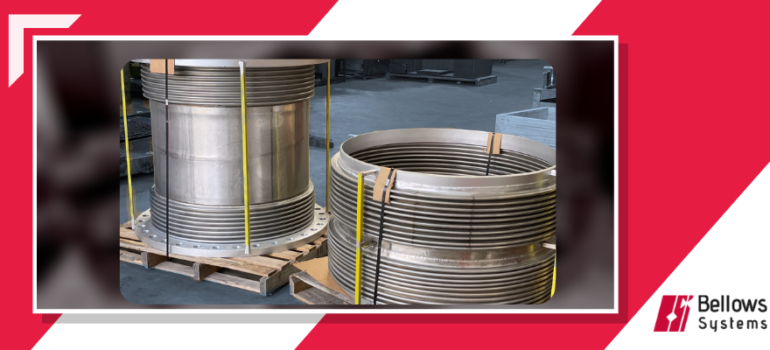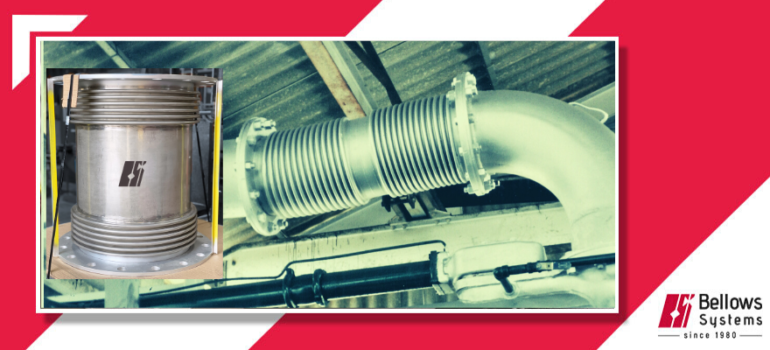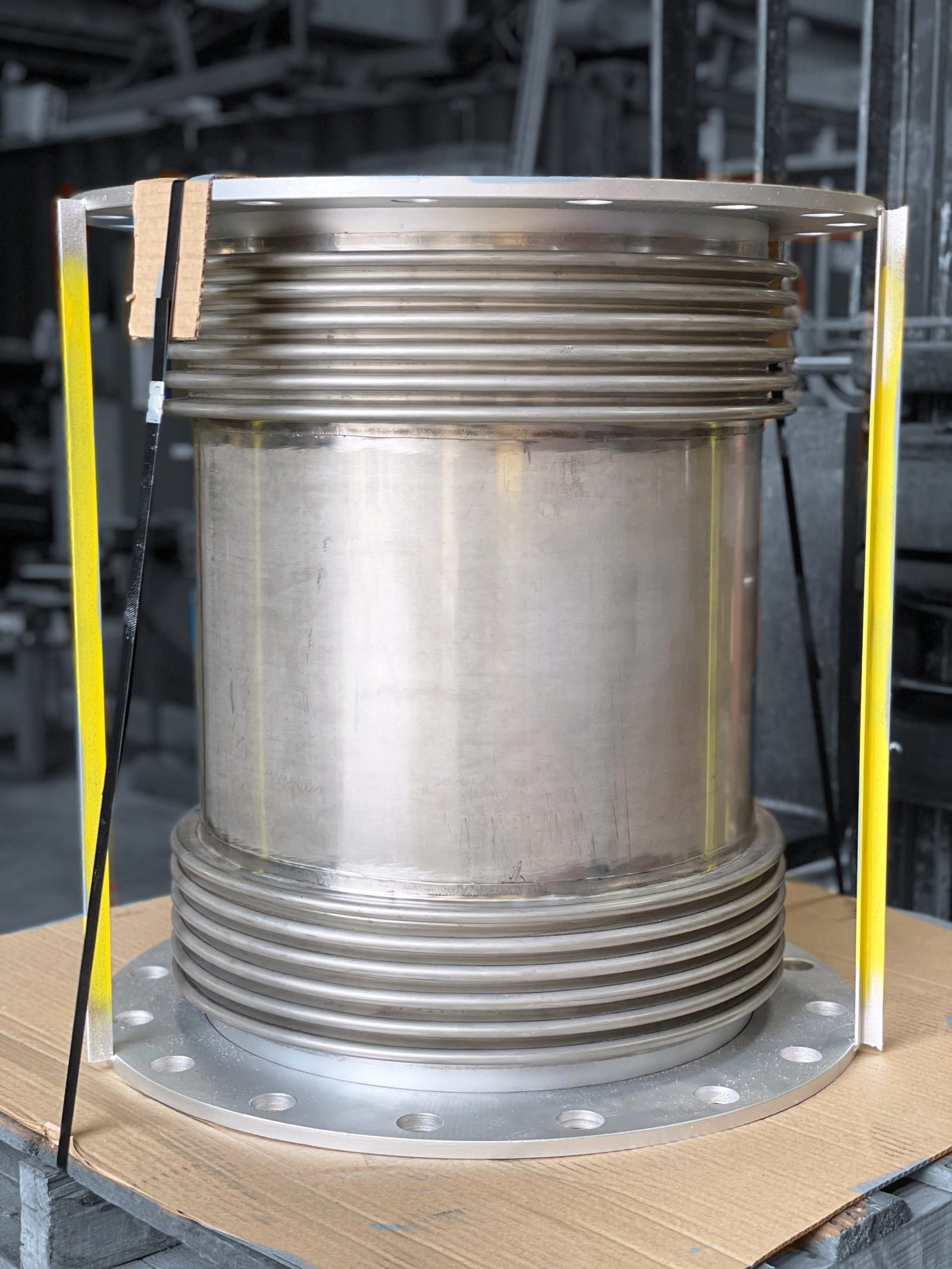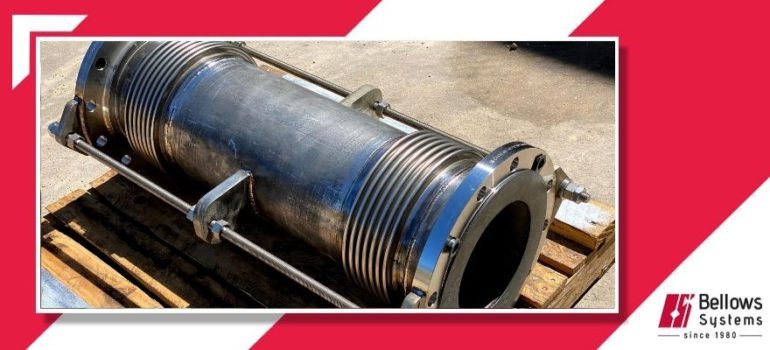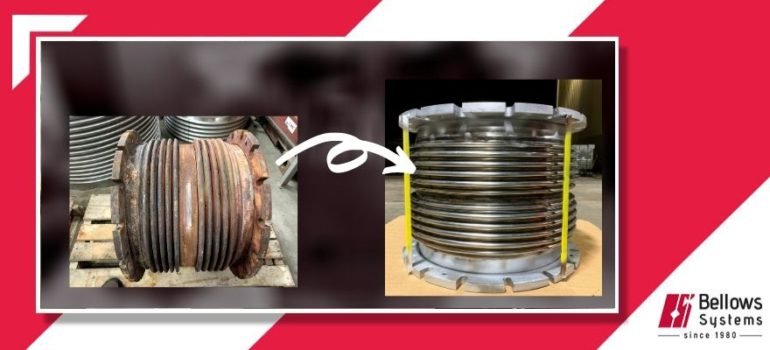
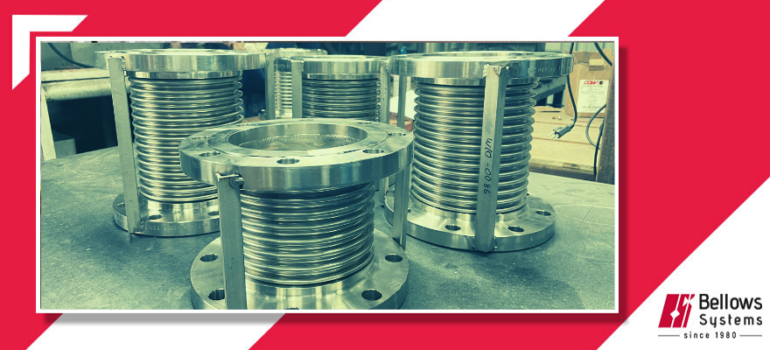
High-Pressure High-Temperature piping Expansion Joints for a Natural Fired Heater at a US AFB.
Design pressure of 1,300 Psi and design temperature of 1,250 F.
Hydrotest at 1,900 Psi
Bellows Systems designed and manufactured one hinged and two gimbal expansion joints for a recent project. The gimbal type expansion joints included one with an external cover and removable insulation. The bellows materials included Inconel 718 alloy construction with integral root rings and collars. Hinge and Gimbal structural components included 304 SS and 347H SS.
Hinged bellows were designed to be capable of 7 degrees of angular rotation at design temperature and pressure.
Bellows Systems is your go-to source for the standard to the most challenging bellows and expansion joint applications.
Bellows Systems shipped another High Pressure Universal Tied Expansion Joint for a process plant piping application. The Expansion Joint had full Stainless Steel 316/ 316L construction & was designed per EJMA 10th Edition & ASME B31.3.
Our expansion jointsare used in both the pulp line and chemical recovery process. Check our expansion joints for our complete line up of products or chat with one of our experienced sales and engineering staff to find the right solution for you.
Recently we received an urgent request for replacement of the main engine (MAN B&W 8S35MC) exhaust compensator (bellows expansion joint) for a LPG Tanker en-route to Houston. Bellows Systems designed, fabricated and delivered the replacement 4-ply exhaust expansion joint within 5 days. Drop-off and pick-up was successfully completed during the vessel’s Houston port call.
We also provide quick turn around repair services on exhaust bellows and expansion joints to vessels calling into port of Houston or Galveston.
Make Bellows Systems your go to source for emergency repairs or rebuilds of exhaust bellows and expansion joints. Call us today to find more about our repair services.
There are several types of expansion joints. Each type of expansion joint is designed to operate under a specific set of design conditions. Some of the most common types of expansion joints are, Single Expansion Joint,Double Expansion Joint,Universal Expansion
PowerGen International 2019 in New Orleans is now open and Bellows Systems is a booth exhibitor in the Texas Pavilion. Looking forward to great days of networking with our clients.
Hydroforming is a metal forming process that swells the material into a die using a high pressure fluid. This forming process is a practical demonstration of Pascal’s Law, which states that external static pressure exerted on a fluid is distributed evenly throughout the fluid.
Hydroforming
Hydroforming is a metal forming process that swells the material into a die using a high pressure fluid. This forming process is a practical demonstration of Pascal’s Law, which states that external static pressure exerted on a fluid is distributed evenly throughout the fluid. This allows us to form complex shapes like the convolutions on a bellows with a high degree of consistency.
Hydroformed Metal Bellows
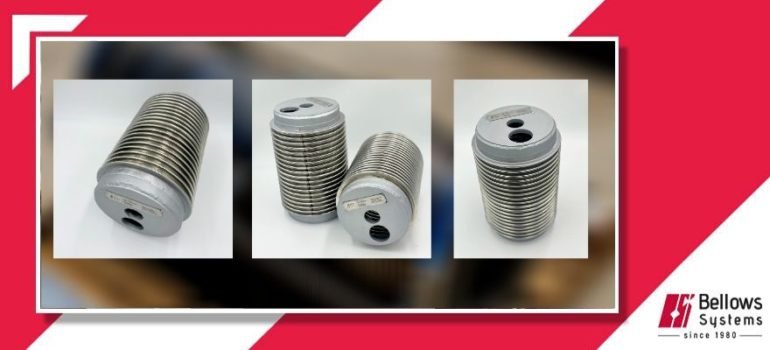
Bellows Systems manufactures the widely known, Kopperman™ Bellows using this method. It is composed of a light gauge metal tube of one or more ply formed into a series of corrugations. Kopperman Expansion Joints can be manufactured with bellows formed from any material which has the necessary drawing quality, and the corrosion resistance required by the operating conditions of the system in which they might be installed. The standard Type 115 Non-Equalizing Expansion Joint utilizes a close-pitch single ply bellows. The standard Self-Equalizing Type 109 and Type 127 Expansion Joint utilizes an open-pitch single ply bellows. The pitch and depth of draw of any bellows can be varied and the shape modified to meet special application requirements. Multi-ply bellows are used primarily on small expansion compensators as standard equipment, and also on other large diameter Expansion Joints where significant reductions in compressive forces are desired. Extreme caution must be employed when specifying multl-ply bellows because they tend to be unstable under certain conditions. Torroidal bellows are very often used where extremely high pressure applications are encounterd.
Standard catalog bellows cover only a fraction of real industrial use cases. If your operating pressure, temperature range, cycle life requirement, material need, or physical geometry doesn’t match what’s in a catalog, a custom metal bellows isn’t just a better option — it’s the only fail proof option.
You’ve opened the catalog. You’ve checked the dimensions. Nothing fits quite right. Maybe the bore is close but the movement rating is off. Maybe the material isn’t compatible with your process fluid. Maybe you need an oval shape and all you’re seeing is circular.
This is one of the most common frustrations for procurement specialists, engineers and plant designers working with bellows. Standard products are designed for the average application — and most applications in oil & gas, power generation, exhaust systems, and industrial OEM manufacturing are anything but average.
Let’s break down exactly when standard bellows fall short, what that actually costs you in the field, and when a custom-manufactured bellows is the right call.
What 'Standard' Metal Bellows Actually Covers
Off-the-shelf or catalog bellows are pre-engineered elements manufactured to fixed dimensions, ply counts, and material grades — usually 304 or 316 stainless steel — with defined movement ratings and pressure ratings.
They work well for:
Low to moderate temperature applications (typically below 800°F)
Common pipe sizes with standard axial or lateral movement requirements
Non-aggressive process fluids compatible with standard stainless steel grades
Moderate cycle life requirements (not continuous high-cycle applications)
Circular cross-section piping systems
The moment your application steps outside any one of these parameters, you’re in custom territory.
5 Signs Your Application Needs a Custom Metal Bellows
1. Your Operating Temperature or Pressure Exceeds Catalog Limits
Standard bellows elements are rated up to defined pressure and temperature limits. High-temperature applications — engine exhaust systems, steam lines, fired heater flues — often exceed these limits. In those cases, you need multi-ply bellows engineered with high-temperature alloys like Inconel 625 or 321SS, designed and stress-analyzed per EJMA standards to handle your specific operating conditions.
2. Your Movement Is Multi-Directional or Unusually Large
Catalog bellows are rated for axial compression, axial extension, or lateral offset — within defined ranges. If your piping system requires simultaneous axial and lateral movement, or the total movement exceeds catalog ratings, you need custom engineering. Over-compressing a standard bellows destroys convolution geometry and causes premature fatigue failure.
3. Your Cycle Life Requirement Is High
Process equipment that starts and stops frequently — engines, compressors, turbines — subjects bellows to thousands or tens of thousands of thermal cycles per year. Standard elements are often not designed with high-cycle fatigue life in mind. Custom multi-ply bellows with optimized convolution geometry and precise wall thickness can be engineered for specific cycle life targets.
4. Your Process Fluid Demands a Non-Standard Alloy
Standard catalog products are typically available in 304SS or 316SS. If your application involves chloride-rich environments, sour gas (H2S), extreme reducing conditions, or high-purity requirements, you need alloys like Inconel 625, Hastelloy C-276, Monel 400, or Titanium — none of which are stocked in most catalogs.
5. Your Geometry Isn't Circular
Rectangular ducts, oval exhaust manifolds, and non-standard bore sizes are common in industrial and OEM applications. Very few suppliers can manufacture non-circular bellows elements. Custom manufacturers with mechanical punch forming and roll forming capability — like Bellows Systems — can produce rectangular, oval, and custom-profile bellows in single or multi-ply configurations.
The Hidden Cost of Forcing a Standard Bellows Into a Non-Standard Application
This is where the math changes. A standard bellows element might cost less upfront. But consider what happens when it fails:
Unplanned downtime — in a refinery or power plant, that’s thousands to hundreds of thousands of dollars per hour
Emergency replacement procurement at premium cost and lead time
Potential collateral damage to adjacent piping, insulation, or equipment
Safety incidents if the failure involves high-temperature or high-pressure media
The total cost of a failed standard bellows in the wrong application almost always exceeds the incremental cost of a properly engineered custom part. This is why experienced procurement teams and plant engineers request custom-engineered bellows even when catalog options appear to “fit.”
The Custom Bellows Process: Faster Than You Think
One of the most persistent myths about custom bellows is lead time. Many buyers assume that “custom” means months of waiting. In reality, a manufacturer with in-house engineering capability, CNC forming equipment, and stocked raw material can turn around custom bellows elements in a fraction of the time you might expect.
Bellows Systems maintains stock of standard-size bellows elements from 1″ through 157″ bore diameter, which can be assembled into custom end configurations quickly. For fully custom designs, BSI’s in-house engineering team works with 3D modeling and stress analysis tools to accelerate the design-to-production cycle.
Scenario
Standard Bellows
Custom Bellows
Material compatibility
304/316SS only
Any alloy: Inconel, Hastelloy, Titanium, Monel
Non-circular geometry
Not available
Rectangular, oval, custom profiles
High cycle life
Limited
Engineered to spec
Multi-directional movement
Limited
Designed for combined movements
EJMA/ASME compliance docs
Often not provided
Standard deliverable
Upfront cost
Lower
Moderate premium
Risk of premature failure
Higher in edge cases
Minimized when properly specified
How to Know Which One You Need — A Quick Decision Guide
Write down your operating pressure, temperature, movement type and amount, cycle life requirement, and process fluid.
Check those values against any catalog spec sheet you’re considering.
If any single parameter is outside the catalog rating — even slightly — request a custom quote.
Ask your manufacturer for EJMA design calculations and 3D stress analysis documentation. If they can’t provide it, that’s a red flag.
The right bellows element for your application isn’t always the one in the catalog. It’s the one that’s engineered to survive your specific operating conditions for the full design life of your equipment.
Need a custom metal bellows for a non-standard application? Talk to Bellows Systems’ engineering team — (800) 233-0623 | bellows-systems.com/get-quote
Related Resources
Single Ply Bellows — ideal for small movements and cost-sensitive applications
Two Ply Bellows — best balance of cycle life and spring rate
Multi Ply Bellows — engineered for high pressure and high temperature